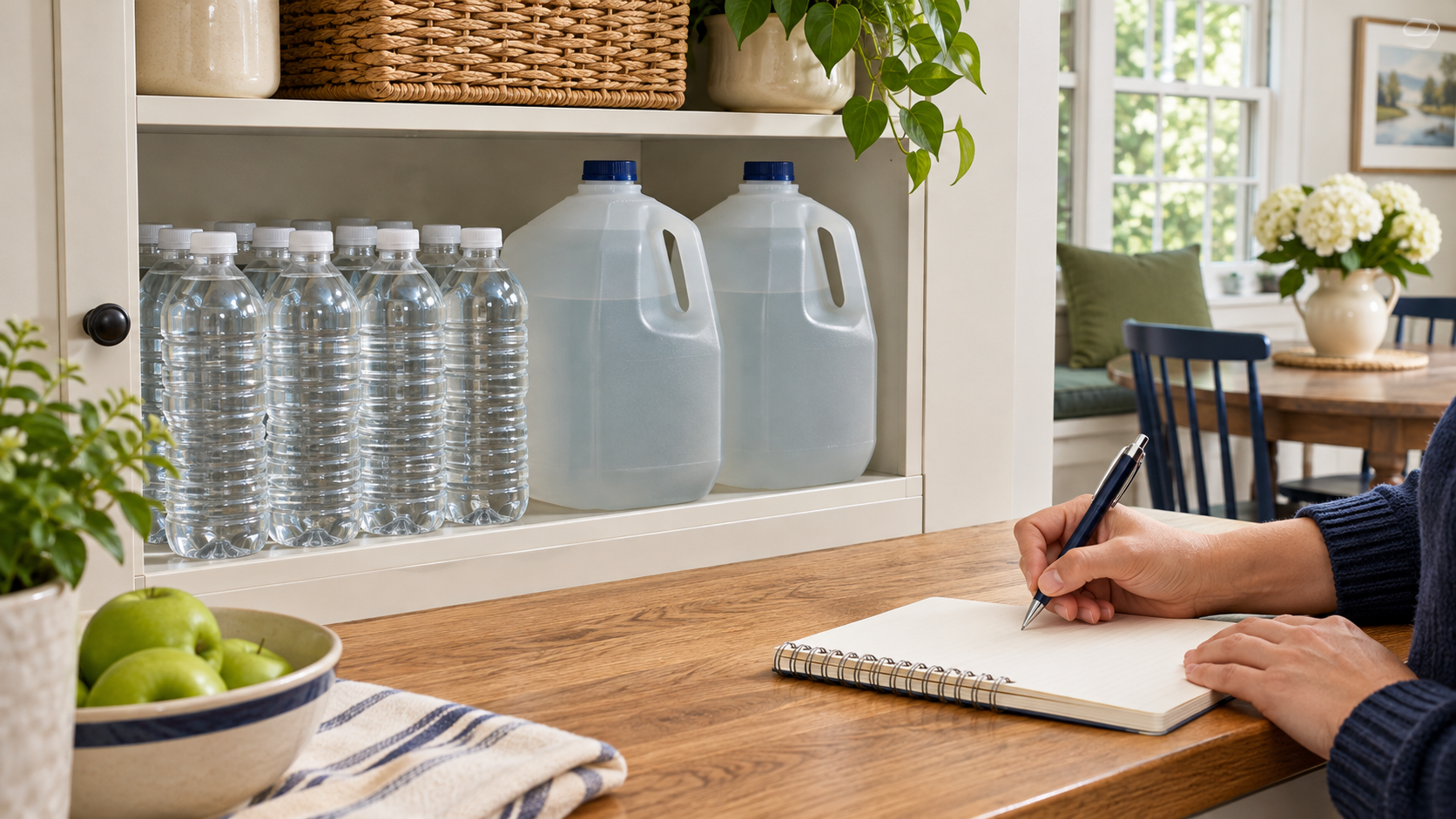
You have several water bottles in the pantry. That feels reassuring until you count the people at home and consider meals, brushing teeth, and other everyday needs.
The gap is not necessarily a lack of supplies. It may be a lack of a clear plan for what those supplies cover.
An emergency water supply becomes more useful when you connect quantity, storage, access, and local information. Start with official guidance, then work through the practical details of your household.
Put a Number on the Starting Supply
CDC recommends storing at least one gallon per person per day for three days. For two people, that starting calculation is six gallons. This is a preparedness quantity, not an individual drinking prescription. CDC
Use the guidance as a starting point and account for additional household needs, pets, climate, and individual circumstances. Seek appropriate professional advice for specialized care requirements rather than assuming a general formula covers everything.
Write down what your planned supply covers and what remains unresolved. A visible limitation is easier to address than an assumption.
Map the Tasks That Depend on Water
List ordinary uses that could be affected by an interruption: drinking, preparing food, personal hygiene, and cleaning equipment used for meals or care.
Check preparation instructions on your stored foods. A pantry built around products requiring water creates a different requirement from suitable ready-to-eat options.
Do not assign alternative water sources to tasks without checking their suitability. During an incident, follow the actual utility and public-health instructions for the water and uses involved.
This planning exercise does not provide water-treatment instructions or establish that an uncertain source is safe.
Choose Containers You Can Actually Manage
Consider who will retrieve, move, and pour from the containers. One large vessel may be inconvenient for a person who cannot safely lift it.
Evaluate suitable smaller containers or an appropriate dispensing arrangement. Follow product instructions and do not compromise the water’s protection to make access easier.
Check the complete task: can the intended user find the container, open it, and use it without unsafe lifting? Make suitable assistance arrangements when needed.
Give the Supply an Appropriate Home
Follow the water product’s and container manufacturer’s storage directions. Check that the location and supporting furniture are suitable, and keep supplies clear of exits, walkways, and safety equipment.
Avoid assuming every reusable container is appropriate for drinking-water storage. Consult current official guidance before preparing your own stored supply, including container selection and preparation.
Keep identifying information available so household members understand the supply’s purpose. Do not mix uncertain water sources into a drinking-water reserve.
Know Where Local Instructions Will Come From
Identify your water provider and the relevant local public-health information source during ordinary conditions. Record their official channels and appropriate contact details.
When a notice is issued, read the affected area, time, and specific instructions. Do not substitute a neighbor’s summary for the original notice or assume instructions from another incident apply.
An interruption and a water-quality advisory can require different decisions. Follow the notice actually issued, including any instructions provided when restrictions change.
If the meaning is unclear, seek clarification through the responsible organization’s published channels. Do not infer safety from appearance alone.
Use a Household Water Worksheet
| Planning question | What to record |
|---|---|
| Who needs supplies? | People, pets, and relevant individual needs |
| What is the starting quantity? | Calculation and assumptions used |
| What tasks require water? | Food preparation, hygiene, and other planned uses |
| Where is it stored? | Suitable locations and container instructions |
| Who can use it? | Lifting, opening, dispensing, and assistance arrangements |
| Where are official updates? | Verified utility and public-health channels |
| What needs attention? | Missing supplies, unresolved requirements, or replacement tasks |
This is an editorial organization tool, not a certification that your supply is sufficient or safe.
Review the Plan After Ordinary Changes
Update the calculation when household membership or needs change. Check stock after use and follow relevant label and official guidance for replacement and storage.
If you change containers, locations, or food supplies, revisit the assumptions those changes affect.
Begin today by counting what you actually have and identifying one unanswered question. A practical water plan makes the quantity understandable, the containers usable, and the next source of reliable information clear.